|
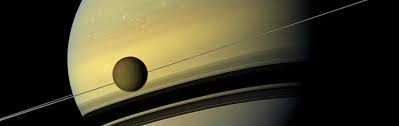
ORBITAL MECHANICS The orbital momentum of planets and moons is the product of the mass, orbital velocity and distance between the orbiting bodies, which balances gravity between the orbiting and orbited bodies, and increasing the mass or velocity of an orbiting body has a multiplier effect on the orbital momentum which increases the orbital distance, and decreases gravity as the orbital distance increases. Scientists thought they knew the rate at which Titan is moving away from Saturn, but they recently made a surprising discovery: Using data from NASA’s Cassini spacecraft, they found Titan drifting a hundred times faster than previously understood — about 4 inches/year.
Titan and Io transform photons induced by mantle heating into protons which transform in exothermic reactions with electrons captured from the solar wind into mantle elements which increases Titan’s and Io’s mass, orbital momentum and orbital distance.
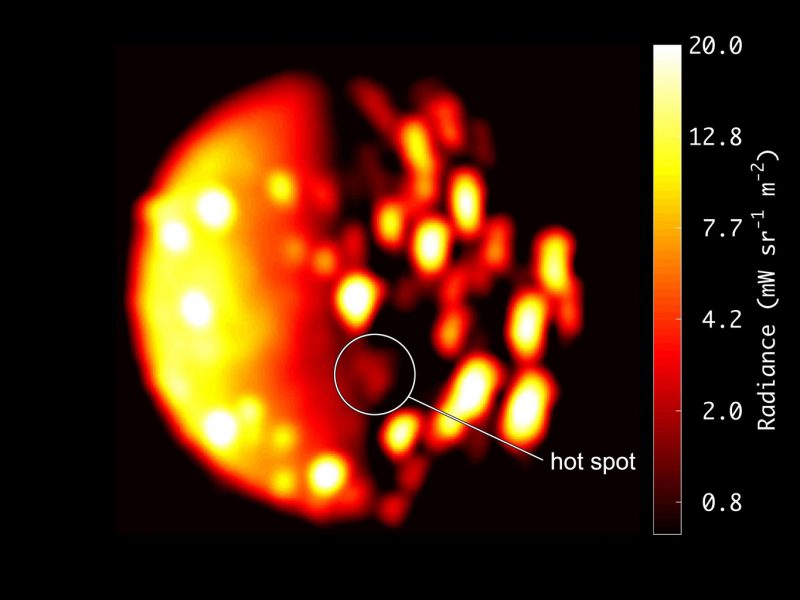
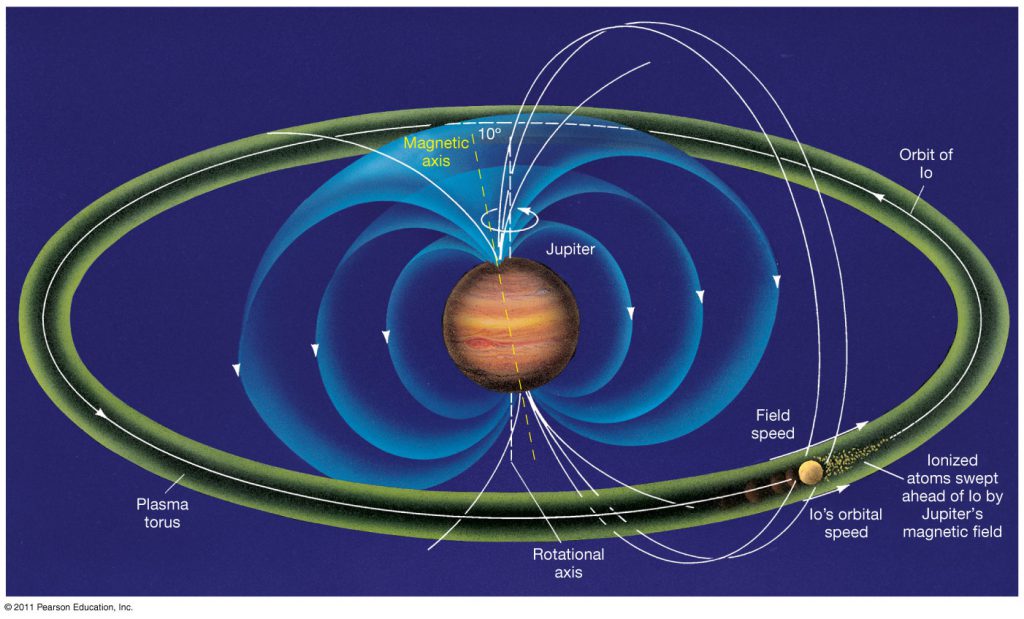
Juneau dedects massive magma lake near Io’s South Pole larger than Earth’s Lake Superior and belches out eruptions six times the total energy of all the world’s power plants. Io’s volcanism has led to formation of hundreds of volcanic centers. Lava flows tens or hundreds of kilometers long have primarily basaltic composition similar to lavas seen on Earth at shield volcanoes such as Kilauea in Hawaii. The ionized rotating cores of stars and planets transform the momentum of moving charges into dipole moments and the sum of moments is captured by their field which increases the momentum of orbiting ions in the direction of core rotation. Dipole moments induced by Jupiter’s rotating core, captured by Jupiters field, powers the high velocity ring current of heavy ions ejected from Io’s volcanoes around Io’s orbital path.
The magnetosphere of Jupiter sweeps up ionized gases and dust from Io’s thin atmosphere at a rate of 1 tonne per second. This material is mostly ionized sulfur, oxygen, chlorine and sodium chloride dust. Io orbits Jupiter with a velocity of 17 km/sec. The Io plasma torus rotates with a velocity of about 74 km/sec. Since Io is embedded in the Io plasma torus, the torus plasma flows past Io with a relative velocity of 57 km/sec.
The three Galilean satellites are involved in orbital resonance, in which the orbital periods of Ganymede, Europa and Io are in a near 1:2:4 ratio and the mutual conjunctions of the Io–Europa pair and of the Europa–Ganymede pair precess around Jupiter at precisely the same rate.
Io and Ganymede are embedded in the high velocity ring current, and block and slow the current which pushes the moons, increasing their velocity, orbital momentum, and radius of their orbits. Io is increasing in mass the fastest of the 3 Galilean moon. One model suggests this resonance was progressively achieved after Io moved outward into a near 2:1 resonance with Europa, and then the Io–Europa pair moved outward until Ganymede was captured into its own near 2:1 resonance with Europa.s The six planets of HD110067 form successive pairs of 3:2, 3:2, 3:2, 4:3, and 4:3 resonances, resulting in the closest planet completing six orbits while the outer-most planet does one. |
Atoms are Electrons and Positrons